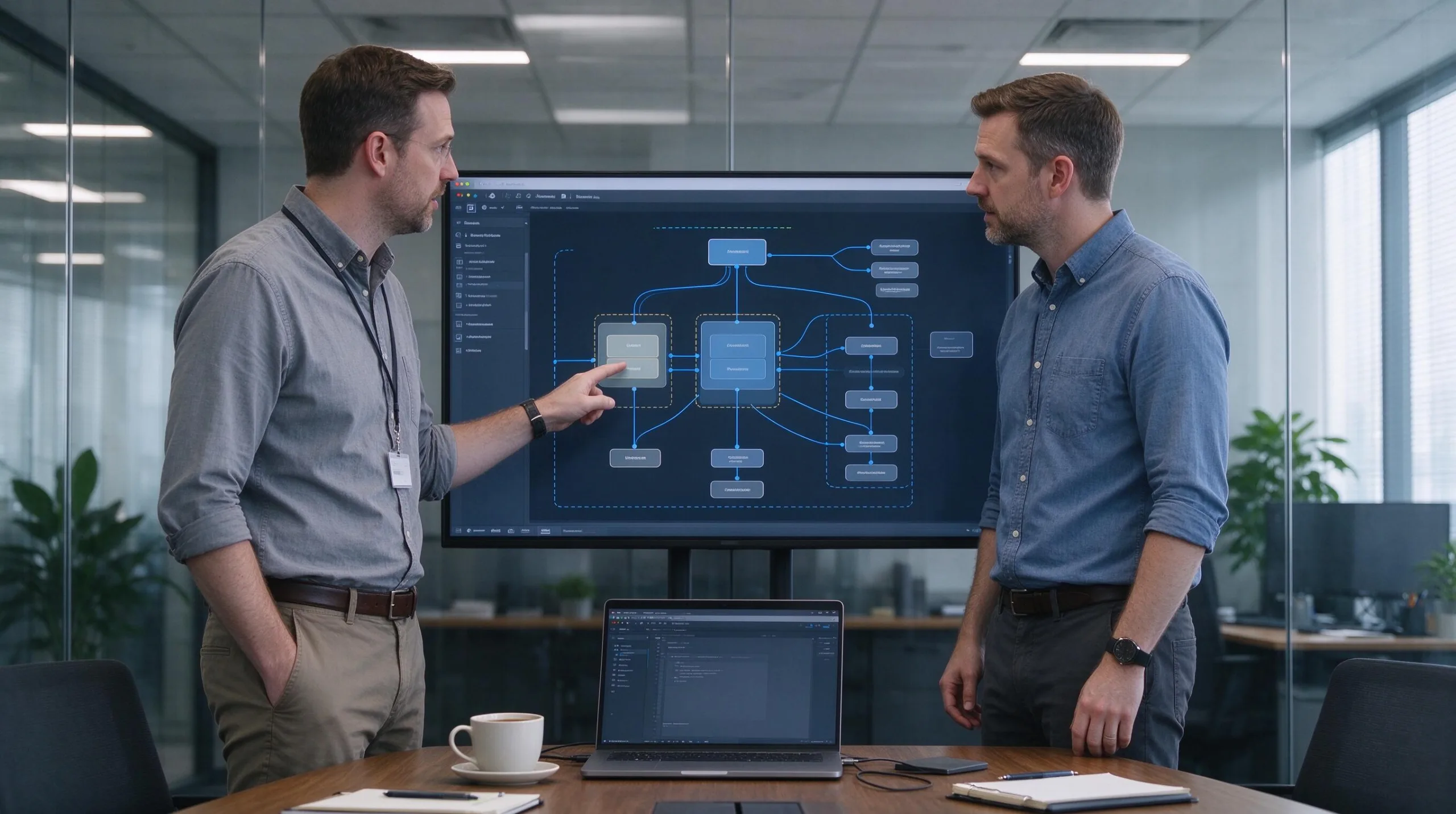
The repository I used for this test was a mid-sized internal tool of roughly eighteen thousand lines. It contained backend services, a modest front-end, shared libraries, and the usual accumulation of solid patterns mixed with shortcuts and latent issues. I selected three vertical slices—an authentication path, a data-processing pipeline, and a form-handling module—and ran the same review request through Muse Spark and two other widely used AI coding assistants under identical conditions.
The goal was not to declare a permanent winner. It was to measure what a small team or independent developer can actually trust when the codebase is large enough that no one holds every detail in working memory.
Designing a Fair Large-Codebase Review
Selecting slices that reflect real pressure
Full-repository review in one pass is unrealistic for both humans and current models. Vertical slices that cut through multiple layers give a clearer signal. Each slice was large enough to stress context handling and cross-function reasoning yet still reviewable in a single focused session. This mirrors how most working developers actually approach unfamiliar or legacy code.
Defining the issues that counted as valuable
I scored findings on security-sensitive mistakes, correctness bugs that could reach production, missing error handling on external calls, and maintainability problems that would slow future changes. Pure style preferences and speculative performance comments were recorded but given low weight. The rubric matches how busy teams triage comments under real deadlines.
Keeping prompts and environment identical
Every assistant received the same instruction: review the supplied code for correctness, security, and maintainability; classify findings by severity; quote the relevant code; and suggest a concrete fix. No custom system prompts or temperature changes were applied. Follow-ups were limited to clarification of findings the model itself had already raised.
Creating a sealed human reference set
Before any AI run I performed a careful human review of the same slices and recorded fourteen issues worth fixing. That list was sealed. After the AI runs I compared every finding against the sealed set and against the other assistants. This is the only reliable way to measure both recall and noise.
Results by Category of Issue
Security-sensitive findings
Muse Spark and one other assistant both identified an authorization check that occurred after a partial data load. The third assistant missed it on the first pass. On an input-sanitization gap, all three noticed the problem; the quality of the suggested fixes varied from precise and local to overly broad. The local, style-consistent fix was the only one that could be applied without additional design discussion.
Correctness and edge-case bugs
Off-by-one errors, unhandled empty collections, and missing null checks were caught at similar rates. Muse Spark more often supplied a concrete input that would trigger the bug, which shortened verification time. One competing assistant produced a higher number of theoretical edge cases that the actual control flow could not reach; each required time to dismiss.
Maintainability and structure
Comments about long functions and unclear naming appeared across all three systems. Muse Spark’s maintainability findings more frequently pointed at code that developers on the project had already flagged informally. Generic “consider extracting this” suggestions were more common from the other assistants and less likely to be acted on by a busy team.
Error handling and resilience
Missing timeouts and absent fallback logging were flagged by Muse Spark and one other assistant with usable, convention-compatible sketches. The third assistant noted the general lack of error handling but rarely proposed a pattern that matched the idioms already present in the repository.
Quantitative Snapshot and Practical Cost
Valid findings versus noise
Each assistant produced between eleven and nineteen findings across the three slices. After human adjudication the share of valid, worth-fixing issues ranged from roughly half to roughly two-thirds. False positives clustered around speculative performance remarks, style preferences that contradicted project conventions, and unreachable edge cases.
Recall against the sealed reference list
Of the fourteen sealed human issues, Muse Spark surfaced nine on the first pass. The other two assistants surfaced seven and six. Misses concentrated on cross-file interactions and business-logic constraints that required assembling information from several locations.
Usability of suggested fixes
A fix counted as usable if it could be applied with light editing and did not introduce new problems. Muse Spark’s suggestions met that bar more often in this codebase, largely because they stayed closer to existing naming, error-handling, and library choices.
Time cost of triaging AI output
Longer narrative comments imposed a higher reading burden. In a real pull-request setting that time competes directly with the time saved by earlier bug detection. Shorter, well-structured findings with clear severity and quoted code proved more practical.
What Small Teams Should Take Away
Where AI review currently adds net value
The assistants are already useful as a first-pass checklist for common security gaps, missing error handling, and certain correctness bugs. They are less reliable as the sole review for business-logic correctness or cross-module consistency. The highest-value pattern is AI first pass followed by human review of both the code and the AI comments.
Reducing false-positive fatigue
Two adjustments cut noise in follow-up runs: an explicit instruction to classify severity strictly and suppress pure style comments, and a short statement of the project’s coding conventions inside the prompt. Teams that skip these steps tend to experience review fatigue and eventually ignore the tool.
Integrating AI findings into an existing process
Treat every AI comment as an untrusted contributor note. Require that each accepted finding be traceable to a concrete location and a clear rationale. This keeps human reviewers in control of the quality bar.
Limits that remain visible
Multi-file reasoning, implicit domain rules, concurrency assumptions, and performance under real load still sit outside reliable reach. Teams that treat AI review as a substitute for human attention on those dimensions will eventually ship the issues the models systematically miss.

Recommendations for Ongoing Use
Base tool choice on your own reference slices
In this repository Muse Spark delivered a favorable balance of valid findings, usable fixes, and moderate noise. Other teams should run the same style of sealed-slice test on their own code rather than adopt any published ranking.
Keep a living set of known issues
A small sealed list of real issues from your repository is the only durable way to measure whether a new model version is actually improving recall. Re-run the slices after major updates.
Spend scarce human attention on the hardest parts
Let the assistant surface the obvious. Reserve human review time for business rules, cross-service contracts, and changes that are hard to revert.
Retire tools that increase net review time
If triaging AI comments costs more time than the bugs they catch save, the tool is not yet helping. Measure that trade-off periodically.
Large-codebase review remains a human responsibility. The assistants that help most are those that surface concrete, verifiable issues and then get out of the way. In this test Muse Spark cleared that bar cleanly alongside capable alternatives. The clean-run discipline—same code, same questions, sealed reference, recorded outcomes—still decides what belongs in a working process.